Lesson summary
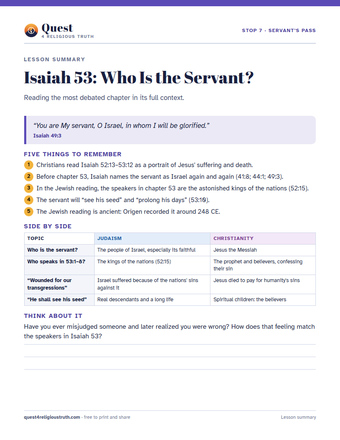
One page: key verse, five things to remember, the comparison chart, and a reflection question.
Finish the quiz to unlockAny score unlocks all three.
All lessons › Stop 7 of 8
Stop 7 · Servant's Pass
Reading the most debated chapter in its full context.
Step 1 of 5 · about 5 min left
Isaiah 52:13–53:12 describes a servant of God who is despised, suffers, and is finally honored. For Christians, it's a clear portrait of Jesus: “He was wounded for our transgressions” (Isaiah 53:5). The New Testament applies it to him (Acts 8:32–35).
Judaism reads it differently. To see why, start where every careful reader starts: the chapters before it.
Chapters of Isaiah. Each blue marker is a verse where the servant is named Israel or Jacob.
Before chapter 53, Isaiah names the servant again and again, and the name is Israel. He even describes this servant as one “whom the nation abhors,” before whom kings will rise (Isaiah 49:7).
Isaiah 52:15 says that “kings shall shut their mouths” at the servant. In the Jewish reading, chapter 53 is those astonished kings speaking: “Who has believed our report?” The nations realize they misjudged Israel, the people they despised.
Jewish readers also point to the details. The servant will “see his seed” and “prolong his days” (53:10). In Hebrew, zera (seed) normally means physical children, and the servant lives a long life after his suffering.
| Topic | Judaism | Christianity |
|---|---|---|
| Who is the servant? | The people of Israel, especially its faithful | Jesus the Messiah |
| Who speaks in 53:1–8? | The kings of the nations (52:15) | The prophet and believers, confessing their sin |
| “Wounded for our transgressions” | Israel suffered because of the nations' sins against it | Jesus died to pay for humanity's sins |
| “He shall see his seed” | Real descendants and a long life | Spiritual children: the believers |
This Jewish reading is ancient. Around 248 CE, the Christian scholar Origen recorded that Jews of his day said the passage described the whole people of Israel. Later commentators such as Rashi, Ibn Ezra, and Radak agreed. Some ancient Jewish writings linked parts of the chapter to the Messiah, but none described a divine Messiah dying for the world's sins.
Key idea
When a chapter is debated, read the chapters around it. Isaiah 40–55 is one long message of comfort to a suffering, exiled Israel.
Pause and ponder
Have you ever misjudged someone and later realized you were wrong? How does that feeling match the speakers in Isaiah 53?
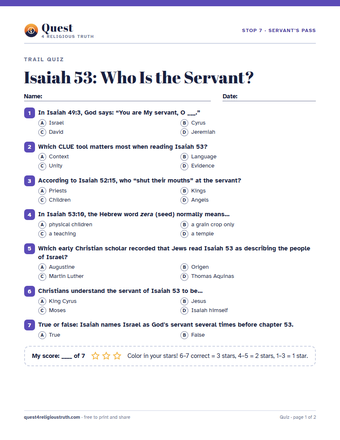
7 questions · about 3 minutes. Finish with any score to unlock three free printables. Tip: press 1–4 on your keyboard to answer.
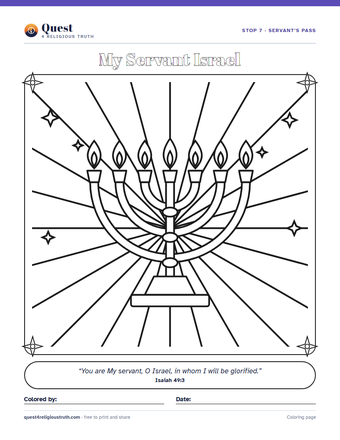
Take your learning away from the screen: read it, quiz a friend, or color while you think.
One page: key verse, five things to remember, the comparison chart, and a reflection question.