Lesson summary
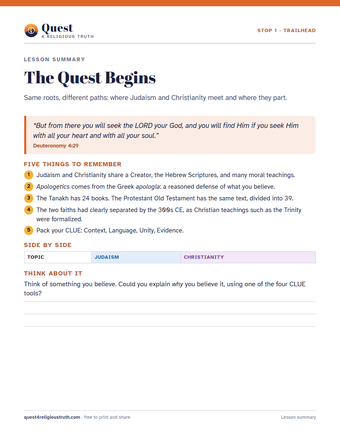
One page: key verse, five things to remember, the comparison chart, and a reflection question.
Finish the quiz to unlockAny score unlocks all three.
All lessons › Stop 1 of 8
Stop 1 · Trailhead
Same roots, different paths: where Judaism and Christianity meet and where they part.
Step 1 of 5 · about 5 min left
Judaism and Christianity are family. They share a Creator, a story that begins with Abraham, and a library of sacred books. Yet on several big questions they give very different answers.
This is a Jewish apologetics course. Apologetics comes from the Greek word apologia, “a reasoned defense.” It has nothing to do with saying sorry! It means explaining why Judaism believes what it believes, with the Hebrew Bible as our map.
“But from there you will seek the LORD your God, and you will find Him if you seek Him with all your heart and with all your soul.”
Deuteronomy 4:29
Key idea
Our goal is understanding, never insults. Christian friends are welcome here, and each belief is described the way its own followers describe it.
Before we look at differences, let's look at the common ground. It's bigger than many people think.
Christians call the Hebrew Scriptures the Old Testament. Jews call them the , a name built from the first letters of its three parts: Torah (Teaching), Nevi'im (Prophets), and Ketuvim (Writings).
Same text, different count. Protestant Bibles split books like Samuel and Kings in two and count the twelve minor prophets separately. Catholic Bibles add seven books that are not in the Hebrew canon.
So when Jews and Christians debate, they often quote the very same verses. The real question is how to read them.
Dates marked c. are approximate; the early dates follow Jewish tradition. Not drawn to scale.
Jesus and his first followers were Jews. Over the next three centuries, Christian teachers formalized beliefs, such as the Trinity, that Jewish teachers saw as contrary to the Torah. By the Council of Nicaea in 325 CE, the two paths had clearly separated.
Read the whole chapter, not just one verse.
Check the Hebrew when a translation seems surprising.
God's word agrees with itself. A new teaching can't cancel an old one.
Ask whether a claim matches what actually happened.
The Torah itself teaches the Unity tool. Deuteronomy 13 warns that even a prophet who performs a real sign or wonder must not be followed if he leads people away from God's commandments. Miracles alone don't prove a teaching true.
Pause and ponder
Think of something you believe. Could you explain why you believe it, using one of the four CLUE tools?
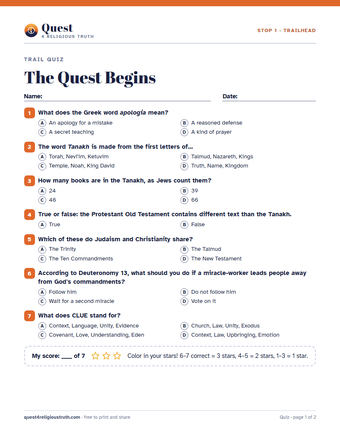
7 questions · about 3 minutes. Finish with any score to unlock three free printables. Tip: press 1–4 on your keyboard to answer.
Take your learning away from the screen: read it, quiz a friend, or color while you think.
One page: key verse, five things to remember, the comparison chart, and a reflection question.