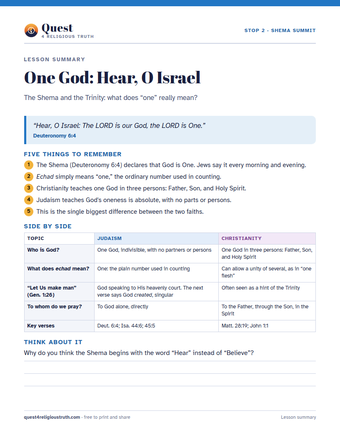
Lesson summary
One page: key verse, five things to remember, the comparison chart, and a reflection question.
Finish the quiz to unlockAny score unlocks all three.
All lessons › Stop 2 of 8
Stop 2 · Shema Summit
The Shema and the Trinity: what does “one” really mean?
Step 1 of 5 · about 5 min left
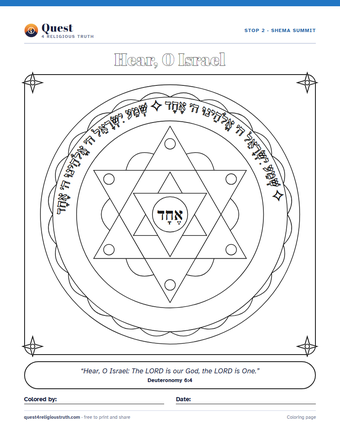
שְׁמַע יִשְׂרָאֵל ה׳ אֱלֹהֵינוּ ה׳ אֶחָד
“Hear, O Israel: The LORD is our God, the LORD is One.”
Deuteronomy 6:4
Read right to left, as Hebrew is written. Out of reverence, Jewish texts write the divine name as ה׳ and say Adonai in prayer.
Jews say the every morning and evening, teach it to young children, and hope to say it with their final breath. It is written on the tiny scroll inside every on a Jewish doorpost.
Most Christians also say they believe in one God. They understand that one God as a : one divine being in three persons, the Father, the Son (Jesus), and the Holy Spirit. Christians stress that this is not three gods.
Some Christians note that echad can describe a group acting as one, as in “one flesh” (Genesis 2:24). They see room for plurality within God.
Judaism
God is One, “and there is no other” (Isa. 45:5).
Christianity
The traditional “Shield of the Trinity”: each person is God, and each is distinct.
Judaism teaches that God's oneness is absolute. God has no parts, persons, or pieces. Echad is the ordinary number “one.” In “one flesh,” the sense of togetherness comes from the word flesh, not from echad.
“I am the LORD, and there is no other; there is no God besides Me.”
Isaiah 45:5
“I am the First and I am the Last; besides Me there is no God.”
Isaiah 44:6
“The LORD Himself is God; there is none other besides Him.”
Deuteronomy 4:35
Notice the words God uses about Himself: “I,” “Me,” “besides Me.”
| Topic | Judaism | Christianity |
|---|---|---|
| Who is God? | One God, indivisible, with no partners or persons | One God in three persons: Father, Son, and Holy Spirit |
| What does echad mean? | One: the plain number used in counting | Can allow a unity of several, as in “one flesh” |
| “Let Us make man” (Gen. 1:26) | God speaking to His heavenly court. The next verse says God created, singular | Often seen as a hint of the Trinity |
| To whom do we pray? | To God alone, directly | To the Father, through the Son, in the Spirit |
| Key verses | Deut. 6:4; Isa. 44:6; 45:5 | Matt. 28:19; John 1:1 |
The first of the Ten Commandments says, “You shall have no other gods before Me” (Exodus 20:3). From a Jewish point of view, worshiping any person alongside God crosses that line. That's why the Trinity is the single biggest difference between the two faiths.
Did you know?
In a Torah scroll, the last letters of the Shema's first and last words, ע and ד, are written extra large. Together they spell ed, “witness.” Each time a Jew says the Shema, he or she becomes a witness to God's oneness.
Pause and ponder
Why do you think the Shema begins with the word “Hear” instead of “Believe”?
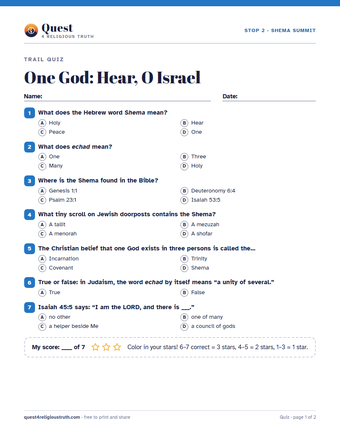
7 questions · about 3 minutes. Finish with any score to unlock three free printables. Tip: press 1–4 on your keyboard to answer.
Take your learning away from the screen: read it, quiz a friend, or color while you think.
One page: key verse, five things to remember, the comparison chart, and a reflection question.